text of this document (ocr, may contain errors)
Page 1
Saab Super turbo
A better way to build boost.
ance two years ago, and promptly ran
headlong into the grief that eventually
confronts all who turbocharge: destruc-
tive detonation. At first, the engineers
applied conventional controls—a lower
compression ratio and moderate boost
pressures—plus a carefully tailored
boost curve that peaked early, then ta-
pered off at the high end of the rev
BY DON SHERMAN
¢ That knocking you hear under your
hood is the sound of efficiency. An oc-
casional metallic rattle means your en-
gine’s probably squeezing all the energy
it can from every drop of fuel, as it was
designed to do. However, a louder,
more persistent rap could mean trou-
ble’s at your door. If you’re not driving
a diesel, your engine’s suffering from
excessive detonation. In time, this heavy
knocking will pound its way through a
piston head and leave you with a very
Pressure sensor
expensive pile of smoking debris.
Treading that fine line between “‘just
a little” and “‘not too much” detonation
is a top-priority technical challenge in
engine labs all over the world today.
Saab has just jumped into the lead in
this particular race with a clever break-
through its engineers have labeled APC,
for “Automatic Performance Control.”
Necessity really did mother this in-
vention. Saab made the shift to turbo-
charged engines for efficient perform-
Detonation sensor
(r
ni
= ions
£
r
Bees
Electronic
Solenoid ae
A
unit
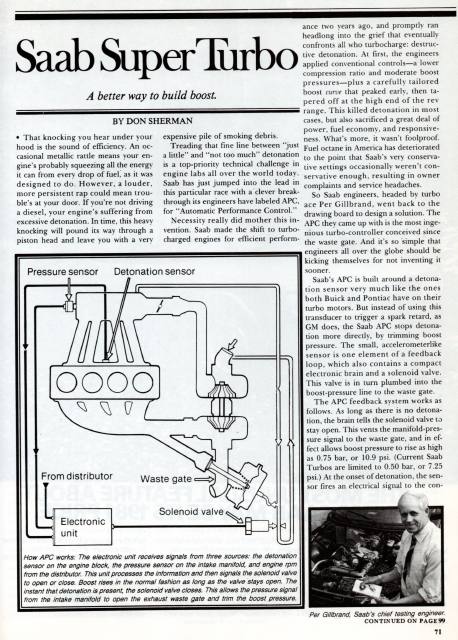
How APC works: The electronic unit receives signals from three sources: the detonation
sensor on the engine block, the pressure sensor on the intake manifold, and engine rpm
from the distributor. This unit processes the information and then signals the solenoid valve
to open or close. Boost rises in the normal fashion as long as the valve stays open. The
instant that detonation is present, the solenoid valve closes. This allows the pressure signal
K]
b
—
from the intake manifold to open the exhaust waste gate and trim the boost pressure.
range. This killed detonation in most
cases, but also sacrificed a great deal of
power, fuel economy, and responsive-
ness. What’s more, it wasn’t foolproof.
Fuel octane in America has deteriorated
to the point that Saab’s very conserva-
tive settings occasionally weren’t con-
servative enough, resulting in owner
complaints and service headaches.
So Saab engineers, headed by turbo
ace Per Gillbrand, went back to the
drawing board to design a solution. The
APC they came up with is the most inge-
nious turbo-controller conceived since
the waste gate. And it’s so simple that
engineers all over the globe should be
kicking themselves for not inventing it
sooner.
Saab’s APC is built around a detona-
tion sensor very much like the ones
both Buick and Pontiac have on their
turbo motors. But instead of using this
transducer to trigger a spark retard, as
GM does, the Saab APC stops detona-
tion more directly, by trimming boost
pressure. The small, accelerometerlike
sensor is one element of a feedback
loop, which also contains a compact
electronic brain and a solenoid valve.
This valve is in turn plumbed into the
boost-pressure line to the waste gate.
The APC feedback system works as
follows. As long as there is no detona-
tion, the brain tells the solenoid valve to
stay open. This vents the manifold-pres-
sure signal to the waste gate, and in ef-
fect allows boost pressure to rise as high
as 0.75 bar, or 10.9 psi. (Current Saab
Turbos are limited to 0.50 bar, or 7.25
psi.) At the onset of detonation, the sen-
sor fires an electrical signal to the con-
Per Gillbrand, Saab’s chief testing engineer.
CONTINUED ON PAGE99
71
Page 2
CONTINUED FROM PAGE71
troller brain, which in turn orders the
solenoid valve to modulate the pressure
signal (upward) fed to the waste gate.
This trims the turbo’s boost and damps
out detonation long before it builds to
destructive levels. The brain also reads
rpm and boost-pressure signals so that,
in the event some component malfunc-
tions, maximum boost can be limited to
0.25 bar (3.6 psi). f
As the name APC suggests, Saab’s
detonation deterrent is fully automatic.
It constantly optimizes boost, and
therefore engine performance over the
entire range of operation, to use all the
octane that’s pumped into the tank. The
system responds in fractions of a second
and quite happily squeezes every last
BTU out of either gasoline or gasohol.
The masterly APC has also paved the
way to several other improvements in
Saab’s turbo motor. The compression
ratio will be bumped from 7.2:1 to
8.5:1, which helps both off-boost re-
sponsiveness and fuel economy. Prelim-
inary tests show 8 percent better gas
mileage with no change in exhaust emis-
sions. APC also fattens up the torque
curve, which in turn speeds up accelera-
tion by roughly 20 percent. (Per Gill-
brand calls the extra torque “‘a byprod-
uct we couldn’t avoid.’’) Even though
APC Saabs are significantly more lively
in response and quicker on their feet,
peak power remains at 135 horsepower,
the design capacity of the front-wheel-
drive transaxle. APC may, however, be a
less expensive approach to turbo power
for Saab. Today’s 900 Turbo uses dis-
crete turbocharger and waste-gate com-
ponents, while the APC system has
them integrated into one unit (AiRe-
search T3).
Which leaves us with but one signifi-
cant drawback to fret over with APC:
these Super Turbos won’t be in produc-
tion before the 1981 model year. ®