text of this document (ocr, may contain errors)
Page 1
The establishment of good anti-corrosion characteristics
must begin when a car is being designed. Thus the
Saab 900 has a monolithic underbody, with no pockets
to accumulate dirt or moisture.
Anti-corrosion measures
The Saab 900 is designed to resist
corrosion. The body is smooth and
has virtually no sharp corners. The
sill members are ventilated to the
inside of the car. The doors are pro-
vided with drain holes. The under-
body has no rust traps. The front
wheel housings are ventilated and
are completely separate from the
fenders and hood, and have no
cavitites that could collect dirt and
moisture—neither on the wheel
side nor the engine side.
The design of the Saab 900 is
quoted as exemplary by the Swed-
ish vehicle-inspection authority,
which has considerable expertise
on the corrosion of road vehicles.
Welded joints are located above
the lowest point of every compo-
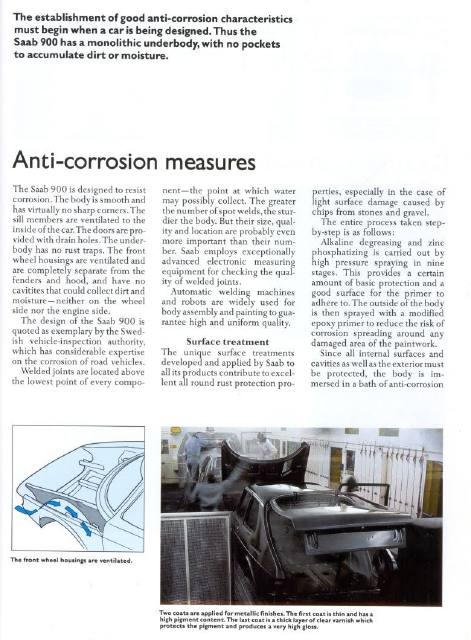
The front wheel housings are ventilated.
nent—the point at which water
may possibly collect. The greater
the number of spot welds, the stur-
dier the body. But their size, qual-
ity and location are probably even
more important than their num-
ber. Saab employs exceptionally
advanced electronic measuring
equipment for checking the qual-
ity of welded joints.
Automatic welding machines
and robots are widely used for
body assembly and painting to gua-
rantee high and uniform quality.
Surface treatment
The unique surface treatments
developed and applied by Saab to
all its products contribute to excel-
lent all round rust protection pro-
perties, especially in the case of
light surface damage caused by
chips from stones and gravel.
The entire process taken step-
by-step is as follows:
Alkaline degreasing and zinc
phosphatizing is carried out by
high pressure spraying in nine
stages. This provides a certain
amount of basic protection and a
good surface for the primer to
adhere to. The outside of the body
is then sprayed with a modified
epoxy primer to reduce the risk of
corrosion spreading around any
damaged area of the paintwork.
Since all internal surfaces and
cavities as well as the exterior must
be protected, the body is im-
mersed in a bath of anti-corrosion
Two coats are applied for metallic finishes. The first coat is thin and has a
high pigment content, The last coat is a thick layer of clear varnish which
protects the pigment and produces a very high gloss.
Page 2
The outside of the body is sprayed with
a modified epoxy primer to reduce the
risk of corrosion spreading round any
damaged area of the paintwork.
To ensure the complete coating of all in-
ternal surfaces and cavities, the body is
immersed in an electrolytic bath of
anti-corrosion paint.
The hood and the surfaces below the
mid-line of the body are sprayed with a
thin coat of a polyester-based paint
which provides extra protection
against stone damage.
Before this polyester paint has dried,
the entire body is sprayed with an in-
termediate coat of modified epoxy
paint.
i y , } ¥
A.
The underside of the floor pan is
sprayed with an anti-corrosion agent.
The electrophoresis method produces a con-
tinuous coat of paint of uniform thickness—
even in corners and around edges.
paint. A strong electric current
causes the paint particles to ad-
here firmly to all internal sheet
metal surfaces. Long electrodes are
inserted into the sill members to
ensure the paint penetrates even
here. The method produces a con-
tinuous coat of paint of uniform
thickness even in corners and
edges.
All joints are sealed with a PVC
sealing compound to prevent
moisture seepage. A polyurethane
compound is sprayed at high pres-
sure on to the underbody, wheel
housings and below the rear wheel
housing trim sections, The final re-
sult is a homogeneous, blisterfree
film, which minimizes the risk of
flaking. Subsequent oven curing
produces a tough surface that is
exceptionally resistant to abra-
sion.
This is followed by a thin coat of
polyester-based paint sprayed on
the hood and below the mid-line
of the body, to provide extra pro-
tection from chips in the finish
caused by stones. Before the layer
of polyester paint has dried, the
entire body is sprayed with an in-
termediate coat of modified epoxy
paint. The door sills are painted in
an anthracite grey trim lacquer.
The polyester paint, intermediate
coat, trim paint and underbody
compound are then baked in an
oven to give an optimal base for
the final top coats.
The intermediate coat is now
rubbed down wet, and the top coat
is applied and oven cured. Two
coats of metallic finish are then ap-
plied: first a thin coat with a high
All joints are sealed with a PVC sealing com-
pound which prevents moisture seepage.
pigment content, then a thick lay-
er of clear coat to protect the pig-
ment and give a very high gloss.
An anti-corrosion agent is
sprayed into more than 50 cavities
and joints in the body. The body is
then heated, ensuring that the
agent seeps into all joints. All parts
which have been mounted on the
underside of the floor pan after
earlier anti-corrosion measures are
sprayed.
A special wax is applied to all
components in the engine bay to
provide protection against mois-
ture and corrosion.
44 But building cars to last deserves
praise and Saab certainly de-
serves praise for the way our par-
ticular 900 has lasted its excep-
tionally arduous 100,000-mile
course. JJ
WHAT CARI
Great Britain