text of this document (ocr, may contain errors)
Page 1
by Larry West
Classic Corner
Hot and
Cold-start
kits for
Bosch CIS
and LH fuel
injection
systems
In an
ideal world, fuel injection
systems Would be able to magically adjust
to every possible condition or situation. In
the 21" century systems like Saab’s Trionic
are approaching that ideal, Theoretically,
you could drive a Saab 9° from northern-
most Sweden, south through Europe, across
the Middle East, and into the Sahara. and the
motor wouldn't miss a beat.
Back in the early days of fuel injection,
this was not always the case. Computer
control was nonexistent or minimal, and
When present, the available memory was
ught. The systems were not able to cope
with the wide variety of environments,
seasons and weather that made up Saab's
markets,
This column will attempt to show what
Fuel Injection kits were available for the
Bosch CIS (K-Jetronic) and LH-Jetronic
systems for USA-market cars. | would
cover the Bosch D-Jetronic system on the
Saab W) up through 1974, but the service
bulletins that [have available don’t go back
that far.
First, a short description of each
system, Note: These descriptions are meant
to be simplistic, and not detailed, Each
system could well warrant it’s own article!
Bosch CIS (K-Jetronic)
CIS is a mechanical fuel
injection system used on Saab
high. Cold start fuel is provided by a
sdlenoid injector mounted in the throttle
body. Regulation of the fuel pressure is
accomplished by a temperature-sensitive
regulator mounted near the thermostat,
CIS is an abbreviation for “Continuous
Injection System’. The ‘Continuous’ comes
from the fact that fuel is injected
continually, not in pulses. Later cars have
Lambda control of the fuel mixture,
regulated by a signal from an oxygen sensor
mounted in the exhaust system, and a
catalytic converter. This system is essen-
tially an “add-on” to the CIS system. By
‘bleeding off some of the control pressure,
the system can adjust the mixture in
response to the signal from an oxygen
sensor mounted in the exhaust.
Bosch LH-Jetroniec
LH-Jetronic (LH) is a true electronic
fuel injection system. The ECU (Electronic
Control Unit) takes signals from a hot-wire
air mass meter, the ignition system, an
oxygen sensor, throttle position sensor and
engine temperature sensor, applies them ta
a ‘map’ stored in EPROM memory, and that
determines how much fuel should be
injected. This is done by varying the time
the injectors are open. All injectors are
pulsed open at the same time. This is called
*bank-firing’.
LH is a German abbreviation for
‘Luftmassenmesser Hitzdraght’, or hot-
Wire air mass meter (AMM). The AMM
allows a much more precise metering of the
air entering the motor than the disc und lever
of the CIS system, Air flowing over a
heated, fine, platinum wire cools the wire. A
bridge circuit (Wheutstone bridge) main-
tains the temperature of the wire, The
amount of current it takes to maintain that
temperature is processed by the ECU as an
indication of the mass of the intake air, A
lerperature sensor corrects the output for
ambient air temperature,
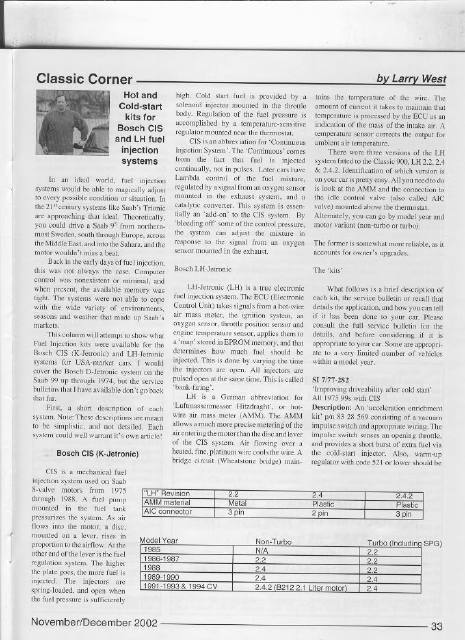
There were three versions of the LH
system fitted to the Classic 900, LH 2.2. 2.4
& 2.4.2. Identification of which version is
on your car is pretry easy. All you need toda
is look at the AMM and the connection to
the idle control valve falso called AIC
valve) mounted above the thermostat.
Alternately, you can go by model year and
motor variant {non-turbo or turbo):
The former is somewhat more reliable, as it
accounts for owner's upgrades,
The ‘kits’
What follows is a brief description of
each kit, the service bulletin or recall that
details the application, and how you can tell
if it has been done to your car. Please
consult the full service bulletin for the
details, and before considering if it is
appropriate to your car, Some are appropri-
ale to a very limited number of vehicles
within a model year.
SI 7/77-282
“Improving driveability after cold start’
All 1975 99s with CIS
Description: An ‘acceleration enrichment
kit’ p/n 83 28 569 consisting of a vacuum
impulse switch and appropriate wiring. The
impulse switch senses an opening throttle,
and provides a short burst of extra fuel via
the cold-start injector. Also, warm-up
regulator with code 521 or lower should be
8-valve motors from 1975 FCA" Revision er) 2.4 2.4.2
through 1988. A fuel pump AMM material Metal Plastic Plastic
mounted in the fuel tank AIC connector Spin 2 pin 3 pin
pressurizes the system. As air
flows into the motor, a disc,
mounted on a lever, rises in
proportion to the airflow. At the ee wes he te Ta tincluaing SP)
other end of the lever is the fuel 1986-1987 22 29
regulation system. The higher Moss 24 29
the plate goes, the more fuel is 1989-1990 24 24
injected, The injectors are [1991-1993 & 1994 GV 2.4.2 (B2122.i Liter moto) | 2.4
spring-loaded, and open when
the fuel pressure is sufficiently
November/December 2002
33
Page 2
Classic Corner
replaced with the 1976-spec regulator of
code $22 or later. On Califormia cars (only)
the thermo-time switch must be replaced
with the 1976 version.
Identification; [f your 1975 99 does not
have the impulse contact mounted along-
side the ignition coil (vacuum hose at the
top, two wires out the bottom), you may
need this kit. 1976 & later 99s and all 900s
do not take this kit, as its function is
standard.
SI 06/79-375
*Shut-Off valve kit — Improving warm start
characteristics’
CIS-equipped 995 1975-1977
Description: Kit 93 04 460. A solenoid
valve is inserted in the retum line from the
warm-up regulator. This prevents rest
pressure loss that results in a hard-to-start
condition.
Identification: a solenvid valve mounted to
the lifting eve bracket,
Summary: Use the kit in extreme
circumstances only. Modem fuels and
filters usually eliminate the need for this kit.
SI 07/80-431
‘Hot Start Kit for fucl-injected (CIS)
engines”
1975-1980 with hard starting when hot,
Description: Kit p/n 78 73 458. Normally,
when starting the motor ‘hot’, the cold-start
injector is not used. This kit will pulse the
cold-start injector if the motor will not stant
after approximately 1.4 seconds. A 0.1
second pulse is followed by a 0.3 second
rest until the motor starts.
Identification: A relay is clipped to the
inner fender near the fuse box, A small
cable with green and yellow wires is spliced
into the wiring to the thermo-time switch.
Summary: The function of this kit is butlt-
in to L981 and later ClS-cquipped Saab
900s. The relay is mounted in the CIS relay
box in the Jeft front fender.
SL 12/81-536
‘Service Campaign no. 502. Replacement
of Acceleration Enrichment Time Relay”
All 1981 900s up to VIN B1023405
Description: The internal circuitry of one
of the CIS relays was changed. The ensures
relay operation and warm start function
over longer cooldown periods.
Identification: The large relay (covering
relay places *B' and ‘C*) is replaced with
34
part #85 71 606. The new relay will have a
yellow dot on the top of the relay,
Summary: Because this is a service
campaign, it will be on record with Saab
Cars USA as to whether the previous owner
had it completed or not. Being that this
campaign is over 20 years old, itis unlikely,
in this writer's opinion, that Saab will honor
the campaign.
SI 06/84-692
“Service kil to improve driveability with
cold engine — certain M82 and all M83
naturally-aspirated 900 (900, 900S)°
Applies to M82 pormally-aspirated cars
with Lambda controller p/n 93 45 216
(Bosch # 0280-800 054) and all M83
Description: Kit pin 85 46 921. An
additional temperature switch is mounted in
the thermostat housing. It is wired to relay E
in the relay box, The kit delays the mixture
reguiation by the Lambda system until the
motor has stabilized on its own,
Identification: Additional temperature
switch in the thermostat housing, close to
the contro] pressure regulator,
Summary: If you don’t have an $2 or 33
non-turbo with the aforementioned Lambda
controller, you can’t use this kit,
SI 09/85-784
‘Improving cold engine driveaway warm
weather”
M84-85 900 models with 8 valve engines
Description: Service Kit p/n 88 18 OLS. Kit
consists of an additional thermo-switch and
wiring. Also requires rearrangement of two
existing femperature switches.
Identification: Thermo-Time switch moved
lo the thermostat housing. Additional
thermo-switeh mounted in the housing,
near the warm-up regulator.
Summary: Useful if you are experiencing
problems with starting and moving the car
‘cold’ at ‘warm’ ambient temperatures in
ithe 60s & low-mid 70s, Easy to install,
Before installing, make sure the injection
system is otherwise operating properly.
SIL0/89-1179
‘Service Kit for cold weather starting
problems’
1985-88 900 models with LH 2.2 Fuel
System
Description: Service Kit 88 18 338. This kit
consists of components to add a CIS-style
‘cold start injector’ to the throttle body,
move one AIC hose connection (in some
cases), and provide the electrical system to
uctuate the cold start injector. A thermal
switch closes its contacts below 20°F and
opens the cold start injector.
Identification: LI 2.2 system with CIS-
style ‘cold start injector’ in the throttle
body; fuel line from cold start injector to
fuel rail; and a thennal switch mounted in
the block drain hole on the exhaust side.
Summary: For cold start problems in
temperatures below 20°F (-7°C). Limited
availability of this kit. The District Service
Manager must approve.
ST 12/90-0073
‘Service kit for cold weather starting
problems in extreme cald weather"
1988-91 900 models with LH 2.4
1991-900 models with LH 2.4.2
Description: Service kit p/n 88 19 O70.
This kit adds a CIS-style ‘cold start injector”
to the throttle body, In temperatures below
5° F (-15° Ci, the LH controller opens the
valve, allowing more fuel into the inlet
airstream.
Identification: Cold start injector mounted
in throttle body; fuel line from cold star
injector to fuel rail. Jumper installed in
wiring near LH ECU,
Summary: [f your car sees these extreme
temperatures, this kit may be warranted.
Other procedures must be undertaken to
ensure applicability.
SI 11/92-0270
‘Driveability improvement: CIS with heated
oxygen sensor’
1988 S00 model (B201 engine) only
Description: Not a kil, but a service
procedure for 1988 “900° cars, The
procedure makes maximum use of the
adjustment specifications, and then, if the
problem persists, installing new compo-
nents. At first, proper lune-up specs must be
met. If they cannot be achieved. or
driveability problems persist, the compo-
nents are replaced as follows:
L. Auxiliary Air Valve p/n 91 14 869
(only approved for the 1988 B201 engine}
2, Remove the spring from the vacuum
impulse contact
3, Fit new Viton injectors p/n 78 56 354
4. Install new warmeup regulator p/n 75
15 554
Identification: No obvious signs, Set
correct tune-up specs, and test driveability.
NINES #260
Page 3
Classic Corner
Summary; Proper tune-up is essential before installing these
parts or any of the kits listed here
In all of the service bulletins, Saab emphasizes that the rest of
the system must be brought up to good working order before
installing any of these kits, This includes checking the condition
of the spark plugs, checking for proper fuel pressures, making
sure that the filters have been « changed, and the timing has been set
properly.
For the best value in service manuals, [| recommend the
Bentley books, There are two, one cover ng the &-valve from
L981 to 1988, and the second covering the 16 valve from 1985
through 1993. These are available from bookstores, including
Amazon.com & Barnes & Noble online.
Some of the cold start kits also tell the technician that in
extreme cold weather, a ‘lighter’ grade of oi! should be used, ie.
SW). (Usually Saab recommends thar SW ar OW off. when used,
must be syvathenc or semi- synthe tic formula. NINES js preparing
a story explaining why! -Ed.) If you seem to be having a
consistent lemperature-related problem with your cur, check the
list and see if there is something that may help you out, There is
really no reason that a fuel injected 99 or 900 should not be
reliable through all temperatures.
Next time, a guest columnist! Gary Stottler will offer advice on
purchasing a Y9
Happy Saabing!
THE SAAB NETWORK
WWW. SAABNET.COM
75,000+ pages of Saab aformation
Frequently asked questions and answers
Chat online with Saab master Technicians
Bulletin Boards - 99, Sconet:, C200, NG9D9, 8000, $-3 anc 9-5
Parici¢ats in monthly online polls
Over 158,000+ Saab visitors gach month
Enter monthly Saab raffles
Free saabre:.cam weo-bas
Buying or selling a Saab?
Jon the saabnet.com mai
SAND COR) ~ es ectured in Coe wre Recerts 2001 Ue
SAAB CONVERTIBLE TOP PARTS
i Cylinder Motor Pump
FROM TWO-STROKE TO TURBO
WE'LL KEEP YOU “SAABIN’
‘71 96 50K, DRIVES GREAT, $4,500
'67 SAABO CARAVAN RARE AND
CUTE, $7500
58 93B WITH SUICIDE DOORS, A
BEAUTY, $8493
1987-94 Stayfast Canvas Tops
120 $199 ‘93 9000 CDE AUTO, 134K, $6,900
‘B9 900 TURSO RAGTOP. AUTO.
— 120K, NEW TOP, S4990
‘87 S000S 5 DR, AUTO, $2,900
‘86 900 TURBO, 5-SPD, 4 RUNNER
ae Down jension cables .. $29.95'pr $2.500
with heated glass wincow ....... $499.00
1987-94 Headline, black. . $149.00
1995 Staylast Canvas Tops
without glass ....... ... $1150.60
1996-98 eee. Canvas Tops
wilhout glass .
HYDRO-E-LECTRIC
Unit 8, 5475 Williamsburg Dr.
Punta Gorda, FL 33982
Call Toll-free 800-343-4261
.. $1000.00
TOM DONNEY MOTORS
FORT DODGE IOWA WWW.DONNEYSAAB.COM
1-§00-626-SAAB
INDEPENDENT SAAB SALES & SERVICE
515-546-6184
Tech Help: 941-639-0437
Fax: 941-639-0376
America's Convertible Headquartars
TRANSMISSION SPECIALISTS - 93/96 MANUALS TO 9000 AUTOS
HIGH PERFORMANCE TORQUE CONVERTER AVAILABLE FOR 9000
November/December 2002
35
Page 4
by Larry West
Classic Corner
| Advanced
| & Technology
Some of you
may know that I
was working on a
| pet project for quite
atime, This project
finally came to
fruition this summer. The project was to
install a Saab Direct Ignition system in a
Classic 900.
My 1986 900 turbo Convertible (yes
one oul Of 352) became the test bed after |
disposed of my red 86 SOOT, which had
rusted rather badly. My main purposes in
making the conversion were to bring the
advanced technology to one of my 900s,
and to prove to myself that it is feasible,
Whether it is all “worth it” is quite another
discussion.
Performance was the bottom of the
list. There are plenty of options for a Saab
with Hall Effect ignition, and indeed, an
aftermarket, stand-alone system that re-
places the ignition, injection and boost
control is probably cheaper, and easier to
install.
How it Works
Saab Direct Ignition (D1) is a coil-on-
plug ignition system. There are no
secondary spark wires, and there is no
distributor. Ignition timing is controlled by
the Electronic Control Unit (ECU), which
receives a signal from a crankshaft-
mounted sensor. There is one coil for each
spark plug. These are mounted in a
“cassette” which fills much of the valley
between the cams, and is screwed to the
valve cover,
The cassette also sends signals back to
the ECU. In particular the cassette, via the
spark plugs, can sense when and whether
combustion actually took place in the
combustion chamber. This tells the ECU
on startup which cylinder is firing, and
synchronizes the timing. On cars with
Trionic, the cassette also functions as the
knock sensor).
The original DI system replaced only
the hall-effect ignition system, Later
systems (and the only ones imported to the
USA) included Saab’s Automatic Perfor-
mance Control (APC) boost control,
creating DI/APC. The advantage here is
that the system has two avenues available
to it to attempt to eliminate knocking.
The first thing a DI/APC system does
is to retard the ignition timing. Often, this
is all that is needed. If not, however, the Dl/
APC can also bleed off boost. As a last
resort, the ECU sends a signal to the LH to
enrich the mixture.
What's Involved
Making the conversion required a lot
of research, much hunting for parts, a
mytiad of electrical connections, and some
mechanical work as well, The research
was what made it all possible. Without the
hours spent poring over manuals, parts
fiche, and service bulletins, the job would
have been a lot harder. One benefit to doing
this type of conversion with a Saab is that
Saab has been such a small company, that
they tend not to change things unless
absolutely necessary. I concentrated on
locating. the common areas in certain
systems between the 900 and 9000.
To give you an example, the shutter
wheel that controls the DI was one area thal
I needed to research. The 9), not having a
— ee ——_ = = = -
a |
Page 5
Classic Corner
DI system, doesn’t have a DI shutter
wheel. But, I recalled that both the
900 and 9000 used EZK ignition on
the B202 non-turbo engines. Start-
ing in 1989, the EZK was triggered
by a crankshaft sensor and shutter
wheel.
Hunting through the parts
books, I found that the 900 and 9000
used the same shutter wheel for the
EZK system. Since the B202 turbo
with DI in the 9000 uses the same
pulley as the non-turbo B202, the DI
shutter wheel from a 9000 should
bolt right up to, and work with, a
main pulley from a B202 non-turbo,
The only thing of concern to me
was that Saab made a change in the
DI shutter wheel about the time they went with the B234 motor.
This was of concern because I had looked at the two pulleys and
there was a disparity in the drilled holes that mount the shutter
wheel, when looked at in relation to the crank keyway. I solved this
mystery by looking at the oi] pump covers. The crank pickup
sensor was rotated (relative to the cylinder centerline) on the
B234. This rotation corresponded to the rotation of the holes in the
pulleys.
Collecting the parts can be easy or difficult, cheap or
expensive. | was very lucky in my parts gathering, picking up used
DI cassettes for $10, ECUs for $20, ete. Stull, I probably spent on
the order of $600 to $700 just for the used parts (but I also have
almost enough parts to do it again). That included $150 for a 195
HP 1990 9000 ‘red box’ ECU, and $150 for two wiring harnesses.
At this point some may be wondering if it’s worth the cost.
Admittedly, other systems can be bought that have greater
controllability, so unless you're like me and just like the
challenge, another aftermarket system is probably a better ‘deal’.
Injection
Though the LH 2.2 should be able to work with the DI/APC,
| opted to also upgrade the injection system to LH 2.4. The main
impetus behind this was improved troubleshooting ability through
the electronic tools. The LH 2.2 has no ‘codes’ to be read. The LH
2.4 does, though they are not always helpful. But this would match
well with the ability of the DI to store codes and tell the technician
what is going on,
Probably the biggest challenges were in making the LH 2,4
happen in a car built for LH 2,2. There is extra wiring, different
circuitry, and relocated circuits. Fortunately, most of the LH
wiring is contained in a completely self-contained harness. I only
needed to deal with the interface between the car and the LH
harness.
Wiring
I was able to work with the LH 2.4 harness off of the car to
integrate it with the DI. Making the DI work was easy, as I tracked
November/December 2003
Saab DI! Cassette installed on a Classic 900.
down some DI wiring from two
9000s. In the 9000 with DI/APC,
the DI hamess is completely
separate from the rest of the car
wiring. It’s not exactly easy to get
out (especially from a junkyard car
without power), but it takes care of
most of the wiring needed to make
DI/APC work in a 900. Once the DI
was integrated with the LH 2.4
harness, and the car was prepared to
accept the harness, it took less than
a weekend to remove the LH 2.2 and
the old ignition, and install the LH
2.4 and DL.
The LH 2.4 fired right up on
the original ignition, but it took me
a few starts and a check of the
wiring to get the DI to fire. There was no problem with my wires,
but an ignition amplifier that was still installed in the fuse box was
pulling down the ignition pulses, so the LH would not give and
fuel! Removing that relay solved the problem.
Next Time
In the next Classic Corner, I'll go over in more detail the parts
needed, and begin to delve into their installation. This series
should run 3 or 4 columns. I hope I'll keep your interest!
INTRODUCING A NEW PERFORMANCE COMPANY
WITH PRODUCTS YOU ALREADY KNOW..
GROUP 9 PERFORMANCE, LLC
Hot AUiea ties te (A athena ue
regulators, our ALD. (now a
exhaust systems, big-bore th
paACKAL
East Coast: 401-421-4876
West Coast: 805-464-0591
Fax: 401-633-6091
www.group9performance.com
+
33
Page 6
by Larry West
Classic Corner
Pa) Dvapc
Conver-
_ sion
Part 2
Parts
Converting a Classic 900 B202 16
valve motor to Direct Ignition (DI) is made
fairly easy by virtue of Saab having used
DI on B202 9000s. Some parts will come
from there, others from 900s which have
EZK from about 1989.
The basic parts that you need forms a
long list, and unless you have a good, cheap
scrapyard nearby, the prices can be rather
high.
Subtle differences
When acquiring parts, it is essential that
you get a set of parts that come from the
same year range. The 1990 B202 DI/APC
works slightly differently than the 1991-
Parts you'll need for the swap
1992 B234 DI/APC. Aside from the extra
0.3 liters of displacement, the 1990 system
uses a manifold pressure sensor, where the
1991 system uses an inlet air temperature
sensor, and on the same ECU pins!
Pull all the bits from a single car, and
you should be fine, The actual DI cassette,
though, is interchangeable.
-DI “Cassette”-
The part that is most noticeable on the
motor. There have been several “upgrades”
over the years, the latest being
part #91 78 955. The only is-
sue with this is the need for an
adapter harness, part # 93 21
787.
-DI ECU-
This is the “brains” of the
operation. It connects to the LH
system, and all of the DI com-
ponents, For the USA, the 1990
ECUs are different from the
1991 & 1992 ECUs.
-Crank Position Sensor-
Two pieces make up the crank sensor,
and two other pieces need to be acquired.
The sensor pieces are a shutter wheel with
three slots (as opposed to the EZK shutter
wheel with two slots) that mounts to the
back of the main pulley, and a hall sensor
that mounts to the oil pump cover.
You must use a main pulley from a
1989 or later non-turbo 900. Some seem to
believe that this pulley can’t handle the
power of the turbo, but I have seen no ill
effects in several thousand miles of driv-
ing, with a used pulley.
The 1989 or later non-turbo 900s use
an EZK ignition with the same crank pickup
arrangement as the DI, only with a differ-
ent shutter wheel.
The oil pump cover has a place to
mount the hall sensor that the shutter wheel
passes through. This place is found only on
the oil pump covers from 1989 and later,
Both turbos and non-turbos should have this
mounting place.
The sensor is electrically identical on
both the 900 with EZK and the 9000 with
DI, the only differences being length of
wires and the body of the connector. Change
from the 900 3-place connector body to the
9000 4-place body and it will mate up to
the harness.
-Knock sensor-
A different knock sensor is used for DI.
It still screws into the same place on the
block.
Crank sensor, oil pump cover
and shutter wheel
4
Page 7
Classic Corner Cont'd.
-APC Valve-
The APC valve is different. It is more
robust, and operates differently. You'll need
one from a 9000 with DI/APC.
Crank sensor and shutter wheel
Photos by the author
-Manifold Absolute Pressure
(MAP) Sensor (1990 & earlier)-
The MAP sensor on the 1990 9000s is
located under the steering column in the pas-
senger compartment,
The inlet air temp sensor (1991 & 1992)
is located on the upper aluminum inlet pipe.
You'll need to have one spot welded onto
one of the 900s pipes if you choose to go
with the later system.
-Wiring Harness-
While not strictly needed, haying a
9000 harness can
make life a lot
easier. Fortunately,
the DI/APC har-
ness is completely
separate from the
rest of the car wir-
ing. The harness
begins at the ECU
under the driver's
seat. You will
need to remove,or
at least move the
driver seat to ac-
the engine bay.
Disconnect the DI cassette, the knock
sensor, the APC valve, the crank sensor and
the inlet temp sensor under the hood, then
go under the seat & dash & pull the harness
into the footwell.
Next time
Next time, I'll expand on the connec-
tions needed to make it all work, There’s a
lot to go over. If you are serious about do-
ing this, get yourself copies of the 9000
manuals for DI and LH.
I would like to take some space here
and thank Steve Goldberger for the fine
work he has done in pulling NINES up by
the bootstraps a few years back, and mak-
ing it into a marquee magazine to be proud
cess the ECU and
harness. The harness
runs from the ECU
to the left door sill
(remove the kick
plate), forward along
the sill, up behind the
kick panel, branch-
ing to the manifold
sensor (1990 & ear-
lier), then through a
rubber grommet into
Adapter harness for DI cassette
laniian:/KCahriian:s ONNA
Part number for latest DI cassette
of. Steve devoted a lot of time to producing
each issue, and I hope now that he is “re-
tiring" we will see more of his in-depth tech-
nical articles in Nines.
And congratulations to Seth
Bengelsdorf on his assuming the editorship
of NINES. I have worked with Seth on The
NEWS (North East Writings on Saab), and
lam sure that the legacy Steve left is in good
hands,
27