text of this document
Page 1
BASIC TRAINING
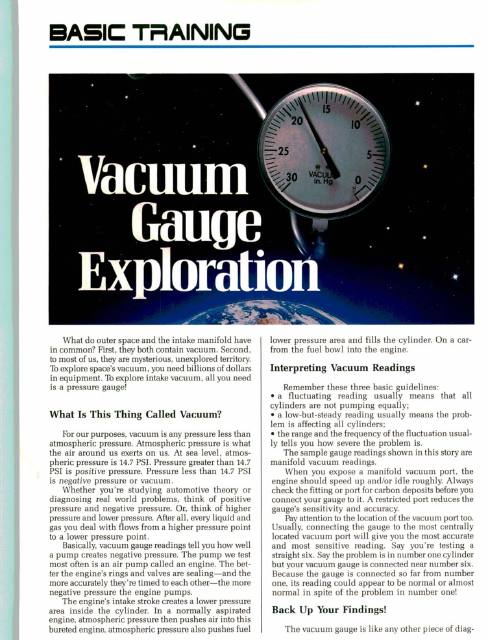
What do outer space and the intake manifold have
in common? First, they both contain vacuum. Second,
to most of us, they are mysterious, unexplored territory.
To explore space's vacuum, you need billions of dollars
in equipment. To explore intake vacuum, all you need
is a pressure gauge!
What Is This Thing Called Vacuum?
For our purposes, vacuum is any pressure less than
atmospheric pressure. Atmospheric pressure is what
the air around us exerts on us. At sea level, atmos
pheric pressure is 14.7 PSI. Pressure greater than 14.7
PSI is positive pressure. Pressure less than 14.7 PSI
is negative pressure or vacuum.
Whether you're studying automotive theory or
diagnosing real world problems, think of positive
pressure and negative pressure. Or, think of higher
pressure and lower pressure. After all, every liquid and
gas you deal with flows from a higher pressure point
to a lower pressure point.
Basically, vacuum gauge readings tell you how well
a pump creates negative pressure. The pump we test
most often is an air pump called an engine. The bet
ter the engine's rings and valves are sealing—and the
more accurately they're timed to each other—the more
negative pressure the engine pumps.
The engine's intake stroke creates a lower pressure
area inside the cylinder. In a normally aspirated
engine, atmospheric pressure then pushes air into this
bureted engine, atmospheric pressure also pushes fuel
lower pressure area and fills the cylinder. On a carfrom the fuel bowl into the engine.
Interpreting Vacuum Readings
Remember these three basic guidelines:
• a fluctuating reading usually means that all
cylinders are not pumping equally;
• a low-but-steady reading usually means the prob
lem is affecting all cylinders;
• the range and the frequency of the fluctuation usual
ly tells you how severe the problem is.
The sample gauge readi ngs shown in this story are
manifold vacuum readings.
When you expose a manifold vacuum port, the
engine should speed up and/or idle roughly. Always
check the fitting or port for carbon deposits before you
connect your gauge to it. A restricted port reduces the
gauge's sensitivity and accuracy.
Pay attention to the location of the vacuum port too.
Usually, connecting the gauge to the most centrally
located vacuum port will give you the most accurate
and most sensitive reading. Say you're testing a
straight six. Say the problem is in number one cylinder
but your vacuum gauge is connected near number six.
Because the gauge is connected so far from number
one, its reading could appear to be normal or almost
normal in spite of the problem in number one!
Back Up Your Findings!
The vacuum gauge is like any other piece of diag-
Page 2
nostic equipment. The more often you use it, the bet
ter you understand it. But although the vacuum gauge
is a great barometer for the engine's mechanical con
dition, you cannot live by it alone.
with timing problems alone don't speed up and
smooth out when you richen them!
Be careful here. On a feedback fuel system, the con
trol computer may have already compensated for air
leaks by richening the mixture. Unless you put the
system into open loop, it will continue compensating
for whatever rich or lean conditions it senses—includ
ing artificial enrichment!
Suppose an engine's suffering from several mar
ginal and/or major problems at the same time. This
combination of problems can alter the accuracy of your
vacuum gauge diagnosis. Before you commit yourself,
always complete the rest of the steps in your engine
analysis—the ignition tests, timing checks, power
balance test, etc.
You can also supplement a vacuum test with
logical follow-up tests. For example, a low and steady
reading could be a big air leak or late ignition/valve
timing. All other things being equal, an engine with
an air leak should respond to artificial enrichment
(choke the air intake or feed it propane). But engines
The typical computer-controlled fuel system de
pends heavily on a sound engine and strong reliable
vacuum signals. Therefore, vacuum readings are as
valuable today as they've ever been. Ask the techni
cian who uses them. He'll say he can't work without
them. Truth is, you can't either!
Normal Cranking Vacuum
Abnormal Cranking Vacuum
In order to start, an engine usually has to pump at least
one inch of vacuum. When cranking, a healthy engine
will pump a fairly steady 3-6 inches. The more
vacuum the engine pumps, the quicker it'll start. The
more cylinders the engine has, the stronger and
steadier cranking vacuum tends to be.
Cranking vacuum is healthy but it drops regularly and
rhythmically. There's a compression problem here.
Every time the weak cylinder tries to fire, two things
happen momentarily: the cranking speed increases
and the vacuum decreases. A burned valve can make
the needle drop regularly to zero vacuum.
Abnormal Cranking Vacuum
Abnormal Cranking Vacuum
When the engine cranks erratically, the cranking
vacuum will also fluctuate erratically. Valve timing
problems (a belt or chain) are the most common cause
of erratic cranking vacuum and cranking speed.
However, the engine could also be so hot it's actually
dieseling during cranking!
Zero cranking vacuum? Before you go crazy looking
for monstrous air leaks, see if the throttle blade(s) are
sticking open. If they are, close them and retest. Unless
the throttle blade(s) are closed or nearly closed, some
vacuum gauges may not respond very well to a crank
ing vacuum test.
The More Things Change . . .
—By Dan Marinucci
Page 3
Normal Idle Vacuum
Abnormal Idle Vacuum
On a normal engine, the idle vacuum should be a
steady reading between 17-21 in/Hg. Larger displace
ment engines tend to produce stronger idle vacuum
than smaller engines do. The better the rings and
valves are sealing, the more vacuum the engine will
A steady, lower-than-normal reading can be a vacuum
leak, an EGR leak, or an ignition/valve timing prob
lem. If it is a vacuum leak, artifically richening the
pump.
mixture will improve idle quality. Richening the mix
ture does't help? Look elsewhere—continue following
your diagnostic procedure.
Abnormal Idle and High-Speed Vacuum
Abnormal Idle and High-Speed Vacuum
When the needle drops regularly and predictably at
idle, one or more valves are leaking. During compres
sion stroke, a burned intake valve allows positive
pressure pulses to enter the intake manifold. When
you rev the engine, the reading doesn't stabilize.
When the reading drops erratically and unpredictably
at idle, a valve or valves are sticking. The needle may
not drop as much as it does when the valve is burned.
If the valves are sticking, cooling the engine down or
using a valve-freeing oil additive may temporarily
steady the vacuum reading.
Abnormal Idle and High-Speed Vacuum
Abnormal Idle/Normal High-Speed Vacuum
When the reading fluctuates sharply between a nor
mal and a very low reading, there may be a compres
sion leak between adjacent cylinders. If so, these two
cylinders will both show up weak on a cylinder
balance test.
Here, the needle slowly wanders back and forth be
tween a normal reading and a slightly lower-thannormal reading. This floating reading tells you the car
buretor is out of adjustment.
Page 4
Abnormal Idle/Abnormal High-Speed Vacuum
Weak valve springs make the needle flutter rapidly-
more rapidly when you rev the engine. Depending
upon RPM and spring condition, the needle may flut
ter irregularly. When weak/broken springs can no
Abnormal Idle/Normal High-Speed Vacuum
At idle, the needle flutters rapidly over a wide area,
but the reading steadies when you rev the engine. This
indicates badly worn valve guides. When the guides
are this worn, the engine has a serious oil consump
longer close a valve, the reading will take on the
tion problem.
Normal High-Speed Vacuum
Comparing Vacuum Signals
At 2500 RPM in neutral, the reading should at least
equal idle vacuum. Usually, vacuum at 2500 will be
greater than idle vacuum. If vacuum at 2500 is less
You can monitor a vacuum device and its vacuum
source simultaneously. For example, connect one
gauge to manifold vacuum and tee the other one into
pumping motion a burned valve creates.
than idle vacuum, disable the EGR system and retest.
If the reading is still low, check for an exhaust
the tranny's vacuum modulator hose. If both readings
don't react the same way during a road test, inspect
the modulator hose and its connections.
Road Testing With a Vacuum Gauge
Choosing the Best Vacuum R)rt
restriction.
Use your vacuum gauge on as many road tests as time
allows. The more you use it, the quicker you'll learn
what "normal" readings are. With an exhaust restric
tion, under-load readings will all be lower than nor
mal and it will take very little throttle movement to
drop the reading to zero.
Whenever possible, connect the gauge to a large, cen
trally located vacuum port. Be sure the port isn't
loaded with carbon deposits! Depending upon engine
and intake design, where you connect the gauge can
make a big difference in the accuracy and sensitivity
of the readings you get!