text of this document
Page 1
BASIC TRAINING
K-letronic
Jr
Last month's look at K-Jetronic showed the impor
tance of both system and control pressures to the
proper operation of the injection system. Now we'd like
to expand on that base.
Checking for correct pressures is not all that dif
ficult, and is essential when troubleshooting a prob
lem child. We'll show you the special fuel gauge you
need and the proper hook-up and test procedures.
We'll also look at those little accessory devices
essential to the cold-start and warm-up needs of the
engine.
In essence, we're building a fuel system, starting
with basic K-Jet, and adding control devices to meet
special circumstances.
It's important, as always, to remember that the fun
damentals we discussed earlier are just that—funda
mental and essential, regardless of how many ac
cessories or controls we may add.
PART TWO
Pressure Testing
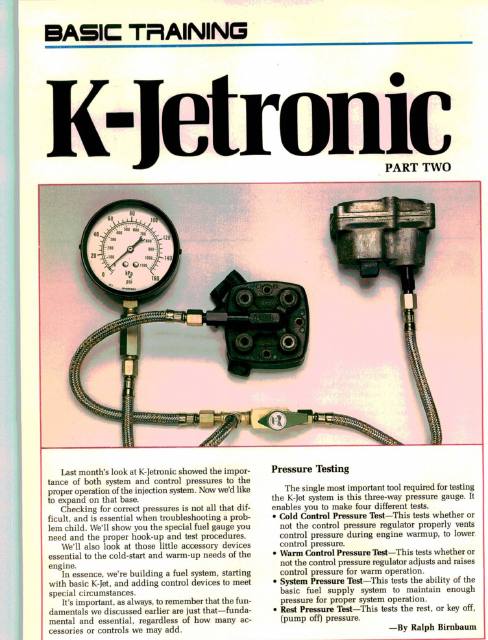
The single most important tool required for testing
the K-Jet system is this three-way pressure gauge. It
enables you to make four different tests.
• Cold Control Pressure Test—This tests whether or
not the control pressure regulator properly vents
control pressure during engine warmup, to lower
control pressure.
• Warm Control Pressure Test—This tests whether or
not the control pressure regulator adjusts and raises
control pressure for warm operation.
• System Pressure Test—This tests the ability of the
basic fuel supply system to maintain enough
pressure for proper system operation.
• Rest Pressure Test—This tests the rest, or key off,
(pump off) pressure.
—By Ralph Birabaum
Page 2
Caution—Contents Under Pressure
Before we get started, please remember to play it
safe with this or any open fuel system. We're going to
crack some fuel lines to do these tests—high-pressure
fuel lines.
We hate to sound like somebody's nagging mother
all the time, but disaster can come with the speed of
lightning, and Molotov cocktails have no place in the
shop. So please, be cool. No smoking. No discon
nected coil wires snapping away madly in a pool of
fuel. Always wear eye protection. Thank you for your
kind attention.
Control Pressure Checks
CONTROL PRESSURE COLD
AMBIENT TEMP 20°C (68":F)
1.4-1.7 bar (20-25 psi)
Connecting the Pressure Gauge
Connect the gauge in-line, between the control cir
cuit output port on the fuel distributor and the con
trol pressure regulator inlet port. The line in question
runs between the control pressure regulator and the
top of the fuel distributor. Be sure to observe the in
structions for using your particular gauge. Some come
with a control valve built in. Others rely on a tee with
disconnect couplings.
Regardless of the style of the gauge, it helps to
remember that we want to "tap into" the line between
these two components without restricting fuel flow so
the gauge can read the control pressure in the line join
ing them.
Take a few moments to bleed all the air from the
gauge hoses to ensure accurate readings. After mak
ing your connections, let the gauge hang down at the
lowest point of the loop formed when you connect the
gauge. Run the fuel pump. Open and close the shut
off valve on the gauge several times with the pump
running. Pause between each opening and closing.
This will purge any compressible air bubbles. Now
hang your gauge upright so you can see it and take
your readings.
Gradually, as the diaphragm in the regulator closes,
the control pressure above the plunger will increase.
If warm control pressure does not reach the warm
pressure specs, check for current at the regulator elec
trical connector, an open circuit in the regulator
heating coil, or insufficient system pressure. Plugged
regulator drillings or lines will give you high readings
all the time.
CONTROL PRESSURE WARM
3.4-3.8 bar (49-55 psi)
As you can see, we want reduced control pressure
with the engine cold. Before testing, disconnect the
electrical connector at the control pressure regulator.
Start the engine. Wait about a minute for the system
pressure to stabilize. Note the reading. Compare your
reading to the chart. Reconnect the plug at the
regulator and watch for control pressure readings to
gradually increase.
If readings are too high when the engine is cold,
either the regulator is bad or something is plugged in
the control circuit. If you remember our photo of the
inside of the regulator from last month's issue, you'll
know how small the drillings are above the control
diaphragm, and how little it takes to clog them.
Page 3
Here's a temperature/pressure chart showing how
the control pressure gradually changes during warm
up. Typical warm control pressure should level off at
Residual Pressure and Leak-Down Testing
3.4-3.8 bar (49-55 psi).
pressure. Stop the engine. (If you use a jumper wire
to run the pump, make sure you remove your jumper
Open the gauge again. Run the engine to build
before testing rest pressure.) With the pump shut off,
we want to test the system's capacity to maintain
pressure at a certain level for a certain period of time
after shut down.
21
14
1.0
System Pressure Check
Leave the gauge connected as we've shown, but
close the control valve. This eliminates the control
pressure regulator from the fuel circuit being tested.
Our available fuel pressure now "dead-ends" at the
fuel gauge. This reading is system pressure. Look for
4.5-5.2 bar (65-75 psi). System pressure too low? Check
This is especially important when diagnosing hot
start problems. If the system bleeds off pressure too
rapidly on a sweltering July afternoon, a five minute
heat-soak may cause percolation of the fuel, making
the car hard to restart
There will be a normal, gradual loss of pressure
over a period of time even when everything works as
it should. We'll have to refer you to the specs for rest
pressure for the car you're working on. Basically, these
specs will tell you that you should have a certain
pressure in the system after x-number of minutes.
If rest or residual pressure disappears too quickly,
however, something, somewhere is leaking
The mechanical action of the spring/diaphragm
combination in the accumulator becomes very impor
tant here. Even if the accumulator is perfect, however,
there are other possible causes of a rapid loss in rest
pressure.
the following:
• Is there fuel in the tank? (Don't laugh, stranger
things have happened.)
• Is the fuel inlet to the pump plugged or partially
plugged?
• Is there any sign of damage to the fuel high-pressure
lines, restricting fuel flow?
• Is there a problem with the fuel pressure regulating
valve? Be careful if you disassemble the valve to in
spect it. There are shims inside which are used to
adjust system pressure. Don't loose them.
• Is the pump good?
Causes of Lost Rest Pressure
• A loose or damaged fuel line. Basically, an external
leak somewhere. This one should be the easiest to
find, but please look without your cigar.
• A leaking fuel pump check ball. An internal leak,
this one is fairly easy to check. If rest pressures drop
too quickly, restart the engine and restore system
pressure. Stop the engine and immediately pinch off
the feed line from the tank to the pump. If pressures
stay up as they should, the outlet check ball is open
and should be replaced.
• A leaking pressure regulating valve in the fuel
distributor. This is another internal system leak
caused when a damaged o-ring at the pressure
regulating valve bleeds system pressure back to the
tank through the fuel return line.
Disassemble, clean, and check the regulating valve.
Replace the o-ring if necessary. Recheck system
pressure and correct it if necessary.
• A leaking accumulator. The accumulator can go bad.
A leaking diaphragm or mechanical defect can keep
the accumulator from doing its job.
• A leaking cold start injector. Pressurize the system
and remove the cold start injector to check for leaks
at the needle valve. The cold start injector gets its
fuel from the lower chamber of the fuel distributor.
Unlike the mechanical injectors at the cylinder ports,
its fuel supply is not interrupted when the control
plunger in the fuel distributor closes after the
engine's shut off.
Page 4
Choke? Fast Idle Cam?
Fast Idle
Carbureted cars have a choke and a fast idle cam
to compensate for all the inefficiencies of a cold
engine. Let's face it, you don't exactly run the fourminute mile at dawn's early light on a sub-zero day.
Remember here that the flow of air past the sensor
plate moves it against the control plunger in the fuel
distributor to increase fuel flow. (You know, the knee
bone connected to the thigh bone, the thigh bone con
Your engine isn't much different.
That engine wants extra fuel and a higher than nor
mal idle speed to get up and at 'em. In addition to a
generally richened fuel mixture, K-Jet uses an elec
trically activated cold start injector to get things going.
The injector is opened by a solenoid, controlled by a
thermo-time switch. It squirts raw fuel into the intake
plenum.
nected to the . . . )
No one wants to sit there playing with the ac
celerator pedal on a cold morning to keep the engine
running, however. What we need is some device to in
crease air flow past the sensor while the engine is cold
and then shut it off once the engine is warm.
Let's install a temporary by-pass around the throt
tle plate and call it an auxiliary air regulator (or air
bypass valve). It is operated by another (you guessed
it) bi-metallic spring. This gate style valve is normally
open, or in this case, open cold.
THERMO-TIME SWITCH-POINTS CLOSED
The same current used to energize the starter
solenoid in the crank position also feeds the time
switch and cold start injector. It travels to the cold start
Since the circuit controlled by the valve "strad
dles" the throttle plate this additional flow of air
through the valve bypasses the throttle and increases
lift at the air sensor, raising engine speed.
Once again, the movement of the bi-metallic spring
closes the gate gradually, eliminating this additional
flow of air. Now you won't have to sit in the car and
hold the accelerator with your foot.
CUTAWAY
1
i 1
% p
M
injector to energize it. It also travels through a heating
coil wrapped around another bi-metallic spring,
similar to the one found in the control pressure
regulator. A set of contact points on the bi-metallic arm
connect it to ground. Ground is also supplied to the
cold start injector as long as the points in the time
switch stay closed.
AUXILIARY AIR VALVE OPEN AND CLOSED
4
THERMO-TIME SWITCH-POINTS OPEN
4I
1
M
As a result, we have crank voltage and ground sup
plied to the heating coil and the cold start injector. The
heating coil warms the bi-metallic spring causing it
to deflect slightly. This movement opens the points,
eliminating the ground circuit to both the switch
heater and injector.
With no ground to the cold start injector we have
an open circuit and the injector stops shooting fuel.
Hopefully, the engine has started by now and the
richened mixture provided by the control pressure
regulator will keep the engine running.
i
As you can see, the heart of this system is fuel
pressure. There's precious little electricity involved in
basic K-Jet, and the need for a good vacuum source
to lift the sensor plate is not radically different from
most other fuel systems.
If you can handle the pressure, you're home free.