text of this document
Page 1
BASIC TRAINING
K-letronic
CONTROL
PRESSURE
REGULATOR
When Moses was a baby, fuel injection was that
mysterious fuel system found on the cars of a few
technically innovative manufacturers. The carburetor,
tried and true, ruled the roost. Those technicians com
petent to repair fuel injection systems were ranked
right up there with magicians, and harder to find.
Unfortunately, the proliferation of injected cars
tinker with injection systems in a simpler time may
have a hard time learning everything at once on the
hasn't necessarily made diagnosis or repair any easier.
We don't just have fuel injection anymore. Now we
have engine control systems. They are sophisticated
and complex. Those technicians who didn't get to
to the point.
newer cars.
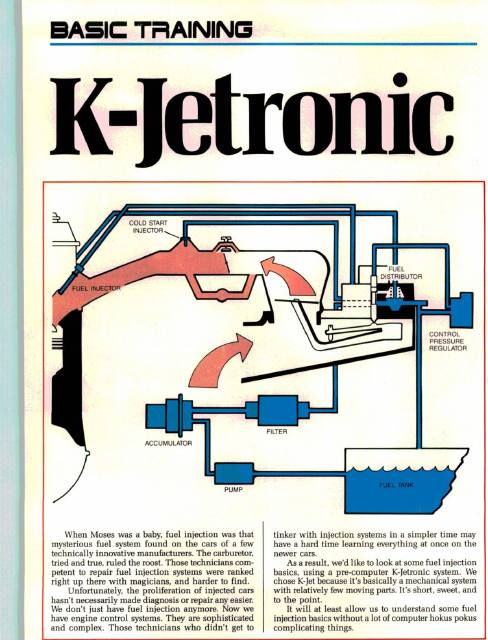
As a result, we'd like to look at some fuel injection
basics, using a pre-computer K-Jetronic system. We
chose K-Jet because it's basically a mechanical system
with relatively few moving parts. It's short, sweet, and
It will at least allow us to understand some fuel
injection basics without a lot of computer hokus pokus
complicating things.
Page 2
—
Let's start with the fuel delivery system. These
photos show the inside of the roller-cell fuel pump.
A notched, armature-driven plate holds small rollers
and turns slightly off center. Centrifugal force throws
the rollers against the sealing walls of the pump
chamber, squeezing the inlet fuel into a smaller space,
pressurizing it.
The pump is cooled by the fuel. It should never
be run dry, even briefly, or it may be damaged.
The pump contains two spring-loaded check balls.
One is located at the pump outlet to prevent system
pressure from leaking back through the pump. It is
available as a separate replacement part.
The other is a non-serviceable pressure relief
designed to dump any excess pressure back to the in
let side of the pump.
Outlet fuel pressure leaves the pump and enters the
accumulator. Fuel pressure enters through a small gate
valve and moves a diaphragm against a large spring.
The mechanical action of the spring works against this
diaphragm to help maintain a residual system pressure
whenever the pump is shut off.
This residual pressure is trapped between the fuel
pump outlet check ball and the rest of the system, pro
viding pressure for the next start and helping reduce
the tendency of the fuel to boil at high temperatures.
Page 3
From the accumulator, the fuel goes to the fuel
filter. We cut this one in half to show the density of
the filtering material. Clean fuel is essential to the
proper operation of this or any other fuel injection
system. This point cannot be stressed strongly enough.
Fuel contamination is the arch-enemy of any fuel
system and fuel injection is especially susceptible to
the problems caused by dirty or contaminated fuel.
Since the fuel pump must have an unobstructed
flow of fuel to lubricate and cool it, this filter is placed
after the pump. Even the engineers know how reluc
tant customers are to indulge in minimum mainte
nance, and they don't want plugged filters allowing
pumps to run dry.
CONTROL
PRESSURE
REGULATOR
From the filter, fuel travels to the fuel distributor.
Pressurized fuel enters a metering chamber. The
passage of fuel through this chamber is controlled by
the position of the control plunger. If you refer to the
illustration, you'll see that the plunger sits on a pivot
arm hooked to the air intake sensor plate.
Negative pressure (or vacuum) from the engine lifts
the sensor plate which lifts the plunger.
As the driver steps on the accelerator pedal, he
opens the throttle. This increases the vacuum at the
sensor plate, lifting it even higher. The control plunger
opens even farther,
allowing more fuel to pass,
although its movement is dampened by fuel pressure
above it.
Page 4
CONTROL
PRESSURE
TO INJECTOR
UPPERCHAMBER
LOWER
CHAMBER
SYSTEM PRESSURE CONTROL
Mil
CONTROL PLUNGER
As you can see, good engine vacuum and a tight
connection between the source of that vacuum and the
sensor plate are essential to the proper operation of
than the system can use, a return line is necessary. The
calibrated restriction in that line is necessary to keep
really foul things up.
restriction in the return like is constantly changed by
a computer-controlled frequency valve, regulating the
this system. Low engine vacuum or an intake leak can
In addition to engine vacuum, the other vital fac
tor in our fuel injection equation is fuel pressure. KJet, unlike L-Jetronic, uses pressure-operated injectors.
With the engine running, these injectors spray con
tinuously instead of being electrically triggered. In
jected fuel waits behind the intake valve until it opens
on the intake stroke, allowing fuel to enter the cylinder.
Once the engine is warm, fuel pressure is kept con
stant at a level greater than the pre-set opening
pressure of the injectors. The fuel mixture is richened
as the control plunger is raised in its bore allowing
a greater quantity of fuel to pass from the lower, or in
let chamber, to the upper, or outlet chamber. Since this
is a port injection system, each cylinder has its own
fuel outlet in the fuel distributor. These outlets are con
trolled by individual pressure regulating valves in the
fuel distributor which maintain a constant pressure
at each outlet port.
The pressure in the lower chamber is controlled
by a spring-loaded pressure relief valve in the return
line to the tank. Since the pump can supply more fuel
system pressure steady. (In closed-loop systems, this
fuel/air mixture, but that's a story for another day.)
When the engine is shut off, the air sensor plate
closes. This allows the control plunger to close,
separating the upper and lower chambers of the
pressure regulating valve. This cuts off all fuel to the
injectors.
The injectors themselves have spring-loaded shutoffs. They are designed to trap residual pressure which
is lower than their opening pressures. Those injectors
which leak down must be cleaned or replaced. In ad
dition to performing badly when the engine is run
ning, they will contaminate the crankcase with raw
fuel at shut-down, and make the car difficult to restart.
Dirt and water are the fuel distributor's greatest
enemies. This is a very high quality component, made
of expensive materials, to exacting standards. The
presence of rust and/or abrasives can destroy its finely
machined surfaces, turning it to junk in short order.
That fuel filter we showed earlier must be changed at
the prescribed intervals to protect this system.
Page 5
CONTROL PRESSURE VENTED
DURING WARM-UP
CONTROL PRESSURE REGULATOR
We're going to add another component to the for
mula now and complicate things a bit. You see, we
need some way to richen the fuel mixture during
engine warm up. We don't have a choke to do the job
for us as we would on a carbureted engine. And since
system pressure is a fixed value, we need to figure a
way to increase the volume of fuel delivered when the
engine is cold.
We're going to add a little device called the con
trol pressure regulator between the chamber above the
control plunger and the fuel return line to the tank.
When the engine is cold, we'll vent some of the
pressure above the control plunger.
With less pressure to overcome, the same amount
of engine vacuum at the air sensor plate will move the
control plunger farther. This will allow more fuel to
enter the upper chamber feeding the injector.
The bi-metallic spring in the regulator overcomes
BI-METALLIC SPRING/
HEATING COIL
the coiled return spring when it's cold. This relaxes
the tension on a small rod that rides against a thin
metal diaphragm in the regulator. With the tension off
the diaphragm, fuel can deflect the diaphragm and
vent to the return line. This reduces pressure above
the metering plunger and richens the mixture.
We mentioned fuel contamination problems
earlier. The photo at top right shows the tiny fuel
passages inside the regulator. When we disassembled
this one for photographic purposes, we found the
center hole plugged with rust and crud.
The photo at bottom right shows the external ports.
A screen is supposed to keep larger pieces of crud from
plugging things up. It can only do so much, however,
before it too becomes clogged.
Page 6
CONTROL PRESSURE DIAPHRAGM CLOSED
As the engine warms up, current is applied to a
small heating element wrapped around a bi-metallic
spring. The bi-metallic spring moves upward, away
from the coiled spring which tensions a small rod
against a steel diaphragm, closing the fuel passages
in the regulator.
Control pressure is more restricted, and this in
creased pressure above the control plunger resists its
upward movement. The same amount of engine
vacuum doesn't lift the plunger as far as it did, and
the mixture is leaned.
This change takes place very gradually as the
engine warms, allowing for a smooth, even transition
from cold enrichment to a normal operating fuel-to-
■
The photo at the bottom right shows the bi-metallic
spring. We turned it so you could read the resistance
specs stamped right on it. We also threw the coiled
spring in there so you could get some idea of its
relative size.
This pressure regulator is extremely important to
the operation of the system. Remember, this is basi
cally a mechanical system. Without correct fuel pres
sure this fuel injection system will not work properly.
air ration.
Our photo at top right shows us testing the
resistance of the heating coil. If control pressure stays
too low even with the engine warm you'll want to
check the resistance on the heating coil around the
bi-metallic spring. This one checks out okay. Also
check at the car harness connector for current.
Before anyone gets ticked off and assumes that this
concludes our coverage of K-Jetronic, let us assure you
that we'll be back with more on this topic next month