text of this document (ocr, may contain errors)
Page 1
DRIVEABILITY CUINIC
STEM:
Y Wiel K-Lambda
BLEM:
ee Stall, Hesitation
iL. COMPONENT:
~ C
ontrol Pressure
Regulator
[v\ TESTS:
K-jet Control Pressure
Three Important Pressures
Welcome to Driveability Clinic.
Starting this month, our new department will
concentrate on common driveability problems on a
specific vehicle or type of fuel system. Unlike past
overview articles, we'll limit each article in this series
toa specific problem, subsystem, or procedure which
can cause all those crazy no-starts, hiccups, stumbles,
and blind staggers.
This month's first edition of Driveability Clinic
will set the general format for the series. It will
present the information about K- and K-Lambda cold
enrichment in the following steps:
1) A system overview illustrating how the pieces
of the cold enrichment subsystem interact.
2) Photos showing individual components and
the internal hardware which makes them work.
3) Specific test procedures.
4) Tips on how to diagnose these systems. When-
ever possible, we'll also include a list of common
problems to help you shortcut diagnosis.
One of the least electrical of all fuel injection
systems used on imports is the Bosch K-Jetronic constant
injection system. The only wiring in the original system
was used to fire the cold start injector, and provide
current to the resistance heater coil in the control
pressure regulator. We’ll look at these in a moment.
We ought to mention that there are three separate
fuel pressures to be measured in this system:
e Main (orsys em) Pressure is the amount of regulated
pressure delivered to the fuel distributor by the fuel
pump.
¢ Residual Pressure is the amount of pressure trapped
in the system after the pump shuts off. Residual
pressure is important for quick restarts of the engine.
It also helps to eliminate fuel percolation at high
temperatures,
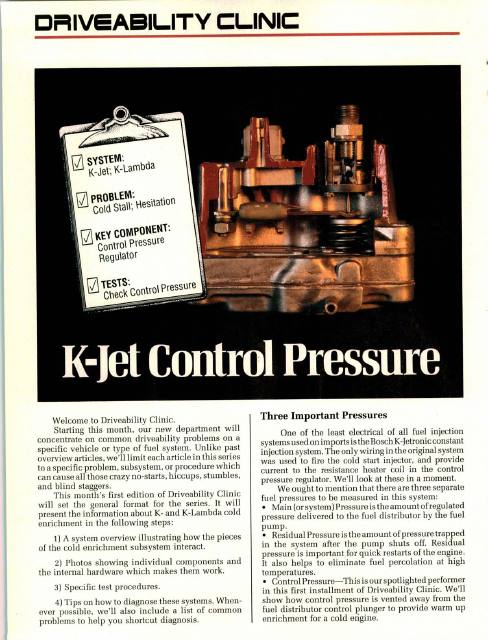
* Control Pressure—This is our spotlighted performer
in this first installment of Driveability Clinic. We'll
show how control pressure is vented away from the
fuel distributor control plunger to provide warm up
enrichment for a cold engine.
Page 2
K-Jet Control Pressure
CONTROL
PRESSURE
TO INJECTOR
SUPPERS
«CHAMBER
LOWER
CHAMBER SYSTEM PRESSURE
CONTROL, PLUNGER
Here's a cutaway view of a fuel distributor. An
internal passage allows system pressure to reach a
chamber above the control plunger. This pressure
pushes the plunger down in its bore. The greater the
pressure above the plunger, the more vacuum it takes to lift
the sensor plate. Less pressure above the plunger makes it
easier for the sensor arm to lift the plunger. The same
amount of vacuum at the sensor plate lifts the plunger
higher, richening the mixture. And a cold engine needs
more fuel.
Control pressure is controlled by the control pres-
sure regulator (big surprise), which is shown in our
photo. It acts as a temperature controlled valve to
vent some of that system pressure away from the head of the
control plunger when the engine is cold. This vented fuel
pressure is returned to the fuel tank through a fuel return
line. The flat bar (arrow) with the two wires attached to it
is a resistance heater similar to a carburetor choke element.
One end of the bar is bolted to a mounting stud in the
regulator body. The other end is attached to a pivot cap and
pin.
When the bar is cold, it flexes downward, overcom-
3 ing the spring pressure below the arm. The pivot cap
and pin move AWAY from the thin diaphragm shown
in our (arrow) photo. With the fuel pump running, system
pressure passes through the internal drilling in the fuel
distributor. Then it exits from the line running to the
control pressure regulator. Without the pin pushing on the
diaphragm, fuel pressure pushes the diaphragm away from
the ports in the regulator, allowing fuel to pass through the
regulator.
TO INJECTOR
Some of the pressure above the plunger is now being
4 vented through the control pressure regulator, and
returning to the fuel tank. Since there’s less pressure
pushing down on the plunger now, the same amount of
vacuum at the sensor plate will lift the control plunger even
higher. This delivers more fuel to the injectors, richening
the mixture to our cold engine. In this respect, the control
pressure regulator acts as a choke does on a carburetor. As
the engine warms, however, the control regulator must stop
venting system pressure.
a.
Page 3
K-Jet Control Pressure
As the bi-metal bar in the regulator warms, it moves
5 toward the diaphragm. The small pin (arrow) presses
against the diaphragm, overcoming system pressure.
The pin gradually pushes against the diaphragm shutting
off the fuel flow through the regulator, back to the fuel tank.
The amount of system pressure above the control plunger
rises. Now there’s a lot more pressure pushing back against
the control plunger. With the same vacuum at the sensor
arm, the plunger doesn’t move as far, leaning the fuel
mixture for warm operation.
Some control regulators have a bellows (arrow) below
the return spring for the bimetal arm. The bellows
move up and down in response to changes in atmo-
spheric pressure at different altitudes. The bellows can also
be connected to engine vacuum and act as a load sensor.
Vacuum applied below the bellows reduces the spring
tension pushing on the bi-metal arm. This lowers control
pressure, and richens the mixture. Check your application,
and use a vacuum pump to check bellows operation. And
don’t forget to check the vacuum source.
Control Pressure Quick Tips
* It’s a good idea to check main system pressure too,
especially if both cold and warm control pressure
readings are low. Improperly adjusted system
pressure, a weak fuel pump, a clogged fuel filter, or
any restriction in the fuel sepplr the fuel distributor
can reduce pressures. A less likely possibility is that
the internal drilling in the fuel distributor is plugged.
+ If control pressure starts out low, and stays that
way, or rises only slightly, the bimetal heating coil
may not be getting hot. Unplug the electrical connector
from the regulator and make sure there's at least 11.5
volts across the terminals when the engine’s running.
Also check the resistance of the resistor on the bi-
metal strip. Look for about 20 ohms.
+ If the car starts but stalls when cold, you know the
cold start injector is not your problem. Remember
that the cold start injector fires raw fuel into the
intake plenum as long as it receives cranking voltage
from the starter circuit and a ground provided by a
cold thermo time switch. Assoon as you stop cranking,
the injector stops firing. If control pressure is too
high, a cold engine starves for fuel as soon as the
injector shuts off.
* Don’t forget the auxiliary air regulator if you have
no fast idle when the engine is cold. While the control
pressure regulator provides added enrichment, it’s
the auxiliary regulator's job to provide fast idle by
providing an air bypass around the throttle plate
when the engine is cold.
+ In addition to control pressure tests, make sure you
eliminate any vacuum leaks both above and below
the throttle plate. A tight vacuum system is vital to
proper sensor plate movement.
+ Higher than normal control pressures can be caused
by any restriction in the control pressure circuit. A
oe line or a pocket of rust or dirt anywhere
etween the chamber above the control plunger and
the return to the fuel tank can cause permanently
high control pressure.
+ Early and late style systems vented return pres-
sure to the fuel tank differently. Systems before 1978
did not have a separate check valve in the fuel return
line. The diaphragm in the control pressure regulator
WAS the shut off. This system didn’t work very well,
and systems after 1978 added a separate check valve
in the main system pressure regulator.
* What you can and cannot do to adjust control
pressure is a matter of discretion, and of course, an
important consideration when exhaust emissions
become a factor. Many shops told us that they have
“tweaked” control pressure by hitting the head of the
bimetal spring’s pivot stud with a punch and hammer,
lowering cold control pressure. In some Cases, a
lowering of control pressure by as little as 0.1 BAR
has eliminated a cold hesitation.
But be warned that this can also affect WARM
emission readings in many cases. The EPA frowns on
this. In many cases, a new regulator may be your only
“legal” fix.
Page 4
K-Jet Control Pressure
Checking Control Pressure
= |
Control
Pressure Regulator
Current To Resistor
Shut Off Valve OPEN
Connect the fuel gauge as shown with
the control valve in the gauge open. (If
your gauge doesn't have a bleeder valve,
you'll need to hold the gauge upside
down and jumper the fuel pump half a
dozen times to purge any air from the
lines.) Disconnect the electrical
connector from the control pressure
regulator and start the engine. Leave the
connector unplugged. Recommended
control pressure for this sample car
should fall between 1.35 and 1.7 BAR at
room temperature (68 degrees F).
Ifcold control pressure is within specs,
reconnect the plug at the regulator.
Leave the gauge valve in the open
position. Control pressure should rise
slowly as the bi-metal spring in the
regulator warms. Note that our
illustration shows the thin metal
diaphragm in the regulator blocking
the flow of fuel to the return line. As
control pressure rises, it pushes down
with more counter pressure against
the head of the control plunger, leaning
the mixture.
Fuel Cannot Pass Through Regulator
th Oe Be