text of this document (ocr, may contain errors)
Page 1
IMPORT.
SEnvice
Driveability Clinic
yo Fuel Pressure
Why is it that the simplest diagnostic tests are often
the last things to be checked? It’s probably because
we've developed a tendency to overlook the obvious
in our search for the “high tech fix.” How many times
have you spent an entire afternoon looking for a prob-
lem, only to find that the whole thing was caused by
something simple like a loose battery terminal con-
nection?
I remember a phone call I made to the N
nostic hotline when I was trying to solve a di
veability problem at the dealership. One of the first
things the helpful voice on the other end of the phone
line wanted to know was what kind of fuel pressure I
had. I had to admit that I didn’t have the answer
because I hadn’t bothered to check. He insisted that I
take a fuel pressure reading, then call him back.
That’s when I realized just how important proper
fuel pressure can be. Think about it. Even the most
sophisticated electronically controlled engine manage-
ment systems have no way of monitoring or control-
ling fuel pressure. The control unit has to assume that
the fuel pressure is being maintained at its intended
level. It bases all of its decisions on that very important
umption.
If the fuel pressure regulator has stuck wide open or
the fuel pump is weak, the control unit isn’t equipped
to recognize it. And even if it could recognize the prob-
lem, its powers to change the situation are also very
limited. The control unit can’t alter fuel pressure, so the
only option is to change the injector duty sycle. And
that’s only an option on systems with electronically
controlled injectors.
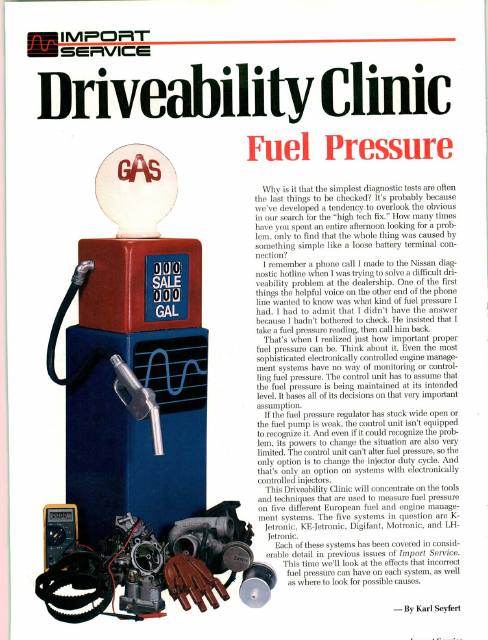
This Driveability Clinic will concentrate on the tools
and techniques that are used to measure fuel pressure
on five different European fuel and engine manage-
ment systems. The five systems in question are K-
Jetronic, KE-Jetronic, Digifant, Motronic, and LH-
Jetronic.
Each of these systems has been covered in consid-
erable detail in previous issues of Import Service.
This time we'll look at the effects that incorrect
fuel pr ssure can have on eac stem, as well
as where to look for possible causes.
é
— By Karl Seyfert
Page 2
K-Jetronic system pressures can exceed 5 bar
(72.5 PSI), so use care when working around
fuel system components or opening fuel lines. To
begin our fuel pressure tests, we'll need a gauge and
hoses equipped with a shutoff valve. Connect the
gauge in-line, between the control circuit output
port on the fuel distributor and the control pressure
regulator inlet port. Fuel must be able to pass
between these two components, without interrup-
tion from the gauge.
| K-Jetronic Control Pressure
Make sure all of the air is bled out of the gauge
lines. The control pressure regulator lowers con-
trol pressure by as much as 2.5 bar when the engine is
cold to richen the fuel mixture. Disconnect the harness
connector at the control pressure regulator, then start
the engine. If the reading is high with a cold engine,
either the regulator is bad or something is clogging the
control circuit. Reconnect the harness connector. Con-
trol pressure should increase to 3.4-3.8 bar at operating
temperature.
2 Measuring Cold Control Pressure
Leave the gauge connected, but close the control
valve. This cuts the control pressure regulator out
of the circuit, causing available “system” fuel pressure
to dead end at the gauge. System pressure should be
4.5-5.2 bar (65-75 PSI) when the engine is warm.
Possible causes of low system pressure include a par-
tially clogged fuel pump inlet, a weak pump, damaged
high pressure fuel lines, a damaged or stuck fuel
pressure regulating valve in the fuel distributor, or a
clogged fuel filter.
3 K-Jetronic System Pressure
K-Jetronic Residual Pressure
Open the gauge, then run the engine to build
pressure. Shut the engine off, then check the
gauge to see if the system holds residual pressure. All
K-Jetronic systems must hold residual pressure for a
set period to assure good hot and cold restarts. Check
the vehicle specs for actual time limits. Possible causes
of rapid residual pressure loss include a leaking fuel
pump check valve, a leaking pressure regulator valve
in the fuel distributor, a leaking accumulator, or a leak-
ing cold start injector.
Page 3
DAIVEABILITY CLINIC
KE-Jetronic Pressure Testing
To measure system pressure on a KE-Jetronic sys-
tem, you'll need a fuel pressure gauge equipped
with a shutoff valve. The gauge must be hooked up
inline, like we did on the K-Jetronic system. Connect
the end of the gauge hose equipped with the shutoff
valve to the cold start injector line. Connect the other
end of the gauge hose to the test port at the lower
chamber of the fuel distributor. Jumper the fuel pump
relay terminals (30 and 87), and measure the system
pressure with the shutoff valve open.
We can’t give the system pressure specs on all KE
systems, but we can give you possible causes if
system pressure is too high or too low. Low system
pressure may be caused by a clogged fuel filter, a leak-
ing pressure regulator (arrow), a weak fuel pump, or
low voltage to the pump. High system pressure may be
caused by a stuck pressure regulator or a clogged regu-
lator return line to the tank. If system pressure drops
when fuel is vented from the regulator into a container,
the return line is clogged.
6 Measuring KE-Jetronic System Pressure
Disconnect the Differential Pressure Regulator
(DPR) harness connector, then close the shutoff
valve on the pressure gauge hose. This keeps system
pressure from reaching the gauge, allowing us to mea-
sure the lower chamber pressure. Jumper the fuel
pump relay contacts, then measure the differential
pressure. It should be 0.2 to 0.5 bar lower than the sys-
tem pressure reading in the previous test. An obstruc-
tion between the upper and lower chambers will cause
a high reading. Suspect the DPR.
‘ Measuring KE-Jetronic Differential Pressure
We test for residual pressure on a KE system the
same way we did with K-Jetronic. Open the gauge
valve, run the engine to stabilize pressure, then shut
the engine off. If the system can’t hold the specified
rest pressure for at least 10 minutes, check the fuel
pressure regulator for leakage at the return line. Other
possible causes of lost residual pressure include leak-
ing lines or connections, a leaking fuel pump check
valve, a leaking cold start injector, or an incorrect fuel
distributor sensor plate adjustment.
8 Measuring KE-Jetronic Residual Pressure
ae) ee
Page 4
DAIVEABILITY CLINIC
A main and an in-tank transfer pump are used
on Volkswagen’s Digifant engine management
system. We'll begin by testing the transfer pump’s
delivery rate. Remove the fuel filler cap, then remove
the sending unit trunk cover. Remove the black fuel
pump feed hose and plug its end. Attach a hose to the
sending unit and route the other end to a measuring
beaker. Remove the fuel pump relay, then jumper ter-
minals 30 and 87. The transfer pump should deliver at
least 300 cc of fuel in 10 seconds.
Gg Digifant Transfer Pump Delivery
Remove the threaded plug at the end of the
fuel rail to test Digifant fuel pressure. Fuel
pressure at idle should be 2.5 bar, and rise to 3.0 bar
when the fuel pressure regulator hose is removed. If
the pressure is higher than normal, check for a restrict-
ed fuel return line, leaking or plugged pressure regula-
tor vacuum signal line, or a damaged pressure regula-
tor diaphragm. Residual system pressure must hold at
2 bar for at least 10 minutes. Use a new sealing washer
when reinstalling the fuel rail pressure tap.
| Digifant Fuel Pressure
Fuel pump volume delivery can be just as
important as fuel pressure, especially on dual
fuel pump systems. To test the Digifant main fuel
pump volume delivery rate, disconnect the fuel return
hose near the right strut tower. We had already re-
moved the fuel rail, so we attached a hose to the pres-
sure regulator and placed the other end in a measuring
beaker. Power the main pump by bridging pump relay
terminals 30 and 87. The high pressure, low volume
main pump must deliver 500 cc of fuel in 30 seconds.
ll Digifant Main Fuel Pump Delivery
Digifant Injector Testing
Volume testing can also be used to accurately
measure fuel delivery from individual injec-
tors. Volkswagen/Audi technicians use a matched set
of graduated cylinders to compare injector delivery.
Place all four injectors in the cylinders, then use a
jumper harness at the pump relay contacts to again run
the pump for 30 seconds. Watch the injectors for uni-
form spray pattern and even fuel delivery. Total fuel
delivery after 30 seconds should nearly equal the vol-
ume collected in the previous test.
a se
Page 5
The Motronic engine management system
found on many BMWs also uses a fuel pres-
sure regulator to adjust fuel pressure to the injectors.
The regulator uses a manifold vacuum signal to deter-
mine the correct amount of fuel pressure to match
engine load. The greater the engine load, the higher the
fuel pressure. When fuel pressure is increased, more
fuel passes through the injectors during the same peri-
od of injector open time. The Motronic ECU can’t con-
trol or monitor fuel pressure.
13 Motronic Fuel Pressure Regulator
Since they’re both air flow controlled fuel sys-
tems with electronic injectors, it shouldn't
come as a surprise that Motronic and Digifant systems
call for the same fuel pressure of 2.5 bar (36 PSI) at idle.
Disconnect the fuel pressure regulator vacuum hose
while watching for a corresponding increase in fuel
pressure. Then shut off the engine. The system should
hold 2.0 bar (29 PSI) for at least 15 minutes after shut-
down. Rapid residual pressure loss may cause hard hot
restarts or long cranking times when cold.
| Measuring Motronic Fuel Pressure
The LH-Jetronic fuel system found on many
Saabs and Volvos also uses an independent
vacuum controlled fuel pressure regulator to adjust
fuel pressure for varying engine loads. Bad fuel pres-
sure regulators account for a high percentage of fuel
pump failures on LH systems. Before you slap a brand
new pump into that high mileage Volvo, hook up your
fuel pressure gauge. A fuel pressure regulator that’s
demanding full fuel pressure at all times will cook the
new pump in short order.
| LH-Jetronic Fuel Pressure Regulator
LH-Jetronic Transfer Pump
Most LH systems also use a low pressure, high
volume in-tank transfer pump. A weak or dead
transfer pump also puts a strain on the main fuel
pump. The main pumps job is to push fuel forward to
the injectors under pressure. The main pump may
overheat and die if it has to syphon fuel out of the tank
for very long. Main pump operation causes a pulsation
in the fuel line that can be felt with your hand. Remove
the fuel filler cap and listen for a buzzing noise that
indicates the transfer pump is working.