text of this document
Page 1
IMPORT
Page 2
Hot Flashes
Swedish auto engineers are apparently sold on the
LH fuel system. LH is installed on all recent model
Saab 900s and 9000s, 700 and 900 series Volvos, and
of course it's still used on the venerable Volvo 240.
The system has been upgraded several times, and it's
gone by a variety of names, from LH II, to LH 2.2, to
LH2.4:
No matter which Swedish name plate you're
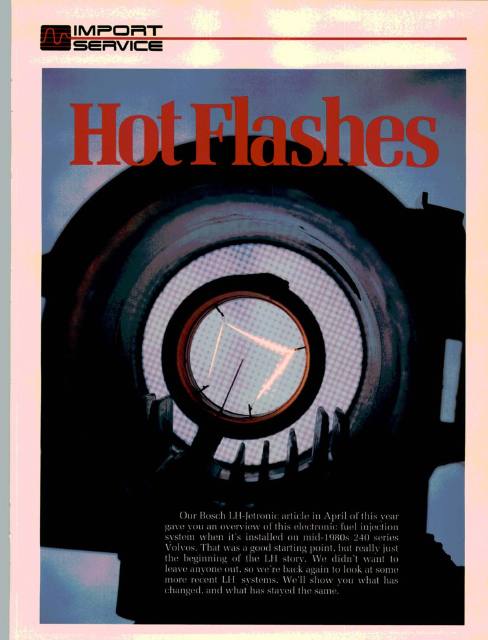
working on, the heart of the LH system in all of its
variations is still the hot wire air mass meter. Its
platinum sensor wire can be seen glowing brightly
at the beginning of this article. All LH systems rely
on this important sensor input to determine changes
in engine load.
Bells and Whistles
Several new features have been added to the ba
sic LH system. Late model Saab and Volvo systems
now have adaptive self-learning ability. This allows
the ECUs in these systems to tailor their outputs to
changing driving conditions, engine mechanical con
dition, driver inputs, and fuel quality. This lets the
engine deliver its maximum output with the lowest
possible emissions at all times.
ECU self-learning also means fewer manual ad
justments for repair technicians. Later LH systems
with self-learning have eliminated the CO adjust
ment screw at the air mass meter. The base idle
adjusting screw has also been eliminated. Both of
these operating parameters are constantly monitored
and adjusted by the ECU, making manual adjust
ment unnecessary.
Self-learning systems work well as long as one
important rule is followed. These systems don't care
much for dirt of any kind. Apparently the engineers
couldn't design in a tolerance for dirt or other de
posits in the throttle housing or idle control valve.
Keeping these two LH components clean takes the
place of routine idle speed and CO adjustments.
To simplify diagnosis, a self-diagnostic system
has also been added to late model Saabs and Volvos
LH 2.4 systems. Fault codes can be pulled out of the
Volvo system without dedicated test equipment. A
small diagnostic socket located behind the left strut
tower is used to retrieve the codes. The diagnostic
socket is also the access point for retrieving ignition
system fault codes. Terminal 2 at the diagnostic
socket is used for the fuel system and terminal 6
handles the ignition system.
There are 18 different fault codes in the LH diag
nostic system. Only three codes can be stored by the
ECU at the same time. If there are more than three
fault codes present, you'll need to repair these prob
lems first, then check for any additional codes. We'll
detail code retrieval, erasure, and other Volvo selfdiagnostic functions in our photo captions.
The Saab LH 2.4 system is a little less user
friendly when it comes to code retrieval. It's neces
sary to locate terminal 2 at a 10 pin connector under
the rear passenger seat. By running a switched
jumper wire between the gray/white wire at termi
nal 2 and ground, fault codes can be read at the
Check Engine light on the dash.
Be sure you attach your ground wire to the cor
rect terminal. Saab warns against grounding any of
the other terminals in the 10 pin connector, or dam
age may result. Whether it's a Saab or Volvo, a
DVOM and a complete system wiring diagram will
still be needed to track down problems after the
ECU has given you all of its fault code information.
Ignition control is still handled by a separate
ECU, even on late model LH 2.4 systems. But the
fuel and ignition ECUs are in much closer communi
cation than they were on earlier models. The Volvo
LH 2.4 fuel system ECU receives RPM, crank posi
tion, and knock control enrichment signals from the
EZ116K ignition system ECU. This is as close as you
can come to an engine management system using
two
separate control units. Maybe two heads are
better than one.
Volvo LH 2.4 Fault Code Key
1-1-1
1-1-2
1-1-3
1-2-1
1-2-3
1-3-1
1-3-2
1-3-3
2-1-2
2-1-3
2-2-1
2-2-3
2-3-1
2-3-2
2-3-3
3-1-1
3-1-2
3-2-2
No faults
Fault in control unit
Fault in injector
Signal to/from air mass meter faulty
Signal missing to/from coolant temper
ature sensor (possible grounding short)
Ignition system RPM signal missing
Battery voltage too low or too high
Throttle switch idle setting faulty
(possible grounding short)
Lambda-sond signal missing or faulty
Throttle switch full load setting faulty
(possible grounding short)
Lambda-sond not operating
Signal missing to/from idle valve
Self-adjusting Lambda-sond not
operating
Self-adjusting Lambda-sond not
operating
Idle valve closed (possible air leak)
Speedometer signal missing
Knock-related fuel enrichment signal
missing
Air mass meter hot wire burn-off
cleaning not working
— By Karl Seyfert
Page 3
Hot Flashes
2
i
Air Mass Meter Failures
If the air mass meter fails, the engine may run poorly
or not at all. To quickly diagnose the sensor, remove
its harness connector with the ignition off. Now start
the engine. The ECU's limp home mode sets injector
pulse width at a fixed value, letting the engine run
at reduced speed.
Coolant Temperature Sensor Failures
An open or short in the coolant temperature sensor
or sensor wiring may cause the engine speed to surge
while driving and cause a high or low idle speed.
Idle speed may race if the sensor goes to an open
circuit after the engine is warmed up. (An intermit
tent failure can make this a diagnostic nightmare.)
4
3
Fuel Pressure Regulator Failures
Fuel pressure regulator failures on Volvo systems
may cause starting problems. The pressure regulator
and the fuel pump check valve maintain rest pres
Correct Fuel Pressure
Proper fuel rail pressure is important for system op
sure after shutdown. Hard hot restarts result if the
eration. A faulty pressure regulator will affect the
system's ability to deliver the correct amount of fuel.
If fuel pressure is too high or too low, either too
regulator vents pressure back to the tank. Vacuum
leaks will also affect operating fuel pressures.
time the injectors open.
5
Clogged Idle Control Valve
Crankcase emissions may form deposits on both
Saab and Volvo idle control valves, causing the shut
ter wheel inside the valve to stick open. To check
the valve operation, clamp its hose closed with hose
pliers. If the idle speed drops several hundred RPM,
remove and clean the valve.
much or too little fuel is going to be injected each
6
Saab 900 Base Idle Set Procedure
Setting the base idle speed on LH systems requires
overriding the idle control valve. The base idle ground
ing lead is in a different location on each LH system.
On pre-1989 Saab 900s, it's the single green wire with
a red tracer at the right inner fender (arrow). Ground
this wire, then adjust the base idle speed.
Page 4
Hot Flashes
7
8
Saab 9000 Base Idle Set Procedure
Early Saab 9000s use a slightly different setup. Re
move the plastic cover.at the left upper corner of the
firewall. Connect a ground wire to the single termi
nal under the cover (arrow). Late model 9000 and
900s with self-learning ability have no external base
idle and CO adjustment points.
turn the thumb screw at the bottom of the throttle
housing to adjust idle speed.
Volvo 7 Series Base Idle Set Procedure
The grounding lead on early 700 series Volvos is
located in the right inner fender area. The red/white
wire also ends at a two wire connector. Later Volvos
with LH 2.4 systems use adaptive self-learning to
control idle speed control. External ground leads
and thumb wheels have been eliminated.
Throttle Housing Deposits
A clean throttle housing is very important, espe
cially on later adaptive systems. Deposits in the
throttle housing cause the throttle plate to hang open
slightly at idle. This throws the ECU a curve as it
tries to adjust the idle control valve to maintain the
correct idle speed and CO percentage.
Throttle Switch Adjustment
Proper throttle switch adjustment is critical on late
model systems, especially those that don't have air
Reading Volvo Fault Codes
The LH 2.4 fuel system on 1989 and later Volvos can
store diagnostic fault codes. A check engine light
warns the driver of fuel system problems. There are
18 different fault codes, but the ECU can only store
three at a time. To read codes, locate the diagnostic
socket at the left inner fender.
bypass screws to adjust base idle speed. After you
have adjusted the idle stop screw or cleaned the
throttle housing on these systems, make sure the
throttle switch is properly adjusted.
Volvo 240 Base Idle Set Procedure
The grounding lead on early Volvo 240 LH systems
is located near the ignition coil at the left inner
fender well. It's a blue wire with a white tracer that
ends at a two wire connector. Ground the wire, then
Page 5
Hot Flashes
14
13
More On Fault Codes
Remove the cover, then connect the selector cable to
pin 2. Turn on the ignition, then press the diagnostic
button for one to three seconds. The LED will flash
three digit fault codes, one code at a time. Press again
to check for additional codes. All stored codes have
been read when the first code is repeated.
Erasing Fault Codes
To erase the fault code memory, leave the selector
cable in pin 2. Turn the ignition on, then press the
button for five seconds. The LED should light within
three seconds after releasing the button. Press the
button again for five seconds with the LED lit. The
LED should go off when the button is released.
16
15
Testing System Inputs
Testing System Outputs
To test system inputs, leave the selector cable in pin
2. With the ignition on, press the diagnostic button
twice (at least one second each time). The LED
should begin flashing rapidly. Open the throttle
slightly. The LED should flash the idle switch code.
If not, the switch is out of adjustment or damaged.
while the LED is flashing.
Three of the system outputs can be tested in the last
diagnostic mode. With the ignition on, press the
diagnostic button three times. The ECU will cycle
the injectors, idle valve, and canister solenoid off
and on. Grab each output to make sure it's clicking
18
17
False Trouble Codes
Some LH 2.4 systems may store false codes for no
apparent reason. Checking the affected circuits may
not turn up anything unusual. Phantom codes can
often be traced to the ECU harness connector. Turn
the ignition off, wait one minute, then remove and
clean the harness connector and ECU terminals.
Oxygen Sensor Failures
Old O2 sensor in LH systems aren't like old soldiers,
they do die. Complaints of high CO readings may be
caused by a dead sensor that's sending a steady lean
signal to the ECU. The customer may not know he
has a problem until the car fails an emissions test.
Replace the sensor at the recommended intervals.
Page 6
Hot Flashes
Charging System Voltage
Like all electronic injection systems, LH depends on
proper input voltage and good grounds. Make sure
the charging system is in order before you start any
Ignition Systems
to these bolts at the top of the intake manifold.
and knock enrichment signal to the LH ECU.
other troubleshooting. The ground leads on this
Volvo LH 2.4 system travel a long way from the ECU
Saab and Volvo LH fuel systems still have separate
ignition systems. The ignition and fuel systems work
together as engine management partners, but use
separate ECUs. The EZ116K ignition system used
with LH 2.4 systems sends an RPM, crank position,
Marlboro
VITTORIOSO
VICTORIOUS
COMPONENTS FOR OVER NINETY PERCENT
WHAT WE LEARN ON THE RACE COURSE
IS DIRECTLY REFLECTED IN OUR
OF TODAY'S FORMULA ONE TEAMS
BRAKE ROTORS FOR THE HIGHWAY
WE DESIGN AND BUILD BRAKE
brembo
1579 SUNLAND LANE. COSTA MESA. CA 92626. PHONE: (714)641-5831 FAX: (714)641-5827
Circle No. 128 on Reader Service Card
1 KELSEY HAYES